
How to Evaluate a Tirzepatide Supplier in a High-Demand Market | B2B Guide
Tirzepatide is a high-demand category, which makes supplier evaluation more important than ever. This guide explains what B2B buyers should check, from communication and documentation to packaging, repeat supply, and category awareness.
3/22/20265 min read
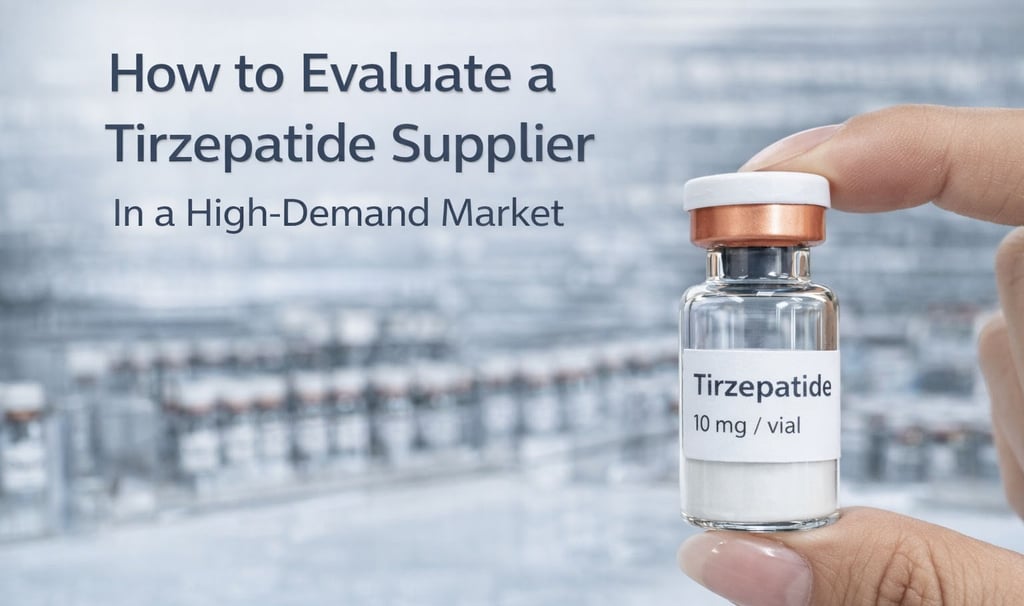
How to Evaluate a Tirzepatide Supplier in a High-Demand Market
Tirzepatide has become one of the most closely watched categories in today’s weight-management market. In the U.S., tirzepatide is the active ingredient in Zepbound, an FDA-approved prescription medicine for chronic weight management in certain adults, used together with a reduced-calorie diet and increased physical activity. Official prescribing information and recent FDA communications also show that this is a tightly scrutinized category with significant regulatory attention.
For distributors, sourcing teams, and project-based B2B buyers, that creates a practical challenge. High demand can bring opportunity, but it also brings noise. When a product category gains attention quickly, the market often fills with inconsistent suppliers, unclear claims, weak documentation practices, and poor communication. In this environment, evaluating a tirzepatide supplier should go far beyond price alone.
This guide explains what B2B buyers should check when assessing a tirzepatide supplier in a high-demand market.
1. Start with supplier communication quality
The first signal is usually communication.
A capable supplier should be able to discuss inquiries in a structured way, including product format, packaging preference, estimated quantity, destination market, and whether the project is stock-based, bulk, or OEM-related. Good communication is not only about replying quickly. It is about answering clearly, consistently, and with enough operational detail to show that the supplier understands how B2B projects are handled.
In a high-demand category, poor communication often creates more risk than price differences. If a supplier gives vague answers, changes details frequently, or avoids practical questions about workflow, that is an early warning sign.
2. Check whether the supplier understands the regulatory sensitivity of the category
Tirzepatide is not an ordinary trend product. FDA has recently warned about illegally sold unapproved drugs containing semaglutide, tirzepatide, or retatrutide that were falsely labeled “for research purposes” or “not for human consumption” while actually being sold directly to consumers for human use. FDA also announced in February 2026 that it intends to take action against non-FDA-approved GLP-1 drugs.
For B2B buyers, this means supplier evaluation should include a basic test of regulatory awareness. A serious supplier should not communicate in a reckless way or rely on obviously problematic positioning. Even if your project is commercial and supply-oriented, the supplier’s language, documentation discipline, and market awareness still matter.
If a supplier seems careless about how tirzepatide is described, packaged, or discussed, that should raise concerns.
3. Review documentation support early
Documentation should be part of the evaluation process from the beginning, not something mentioned only after payment discussions begin.
A stronger supplier should be prepared to discuss documentation such as:
product specification information
batch-related materials
packaging details
label review items
project files for OEM coordination
other evaluation materials relevant to B2B review
This is especially important in a high-demand market because buyer scrutiny is higher, and product legitimacy questions come up more often. A supplier who treats documentation as an inconvenience rather than a standard business requirement may not be a good long-term partner.
4. Evaluate packaging and presentation consistency
In many B2B projects, packaging is part of supplier quality.
That does not only mean custom boxes or private-label design. It also means consistent presentation, clear labeling logic, organized batch identity, and a packaging workflow that can be discussed professionally. If your project may involve OEM, private label, or repeat orders, the packaging side matters even more.
A capable supplier should be able to explain the difference between standard supply and customized packaging projects, including what information is needed to move forward and how confirmation is handled before production.
5. Ask how they handle repeat supply
A first order is one thing. Repeatability is another.
For distributors and long-term buyers, the more important question is whether the supplier can support ongoing procurement with a stable process. That includes communication consistency, repeat-order handling, packaging continuity, and reasonable coordination around future demand.
This point matters even more in a category that has already experienced major supply pressure. FDA stated that tirzepatide injection had been in shortage since 2022 because of increased demand, and later determined that the shortage was resolved and removed tirzepatide injection products from the FDA drug shortage list on October 2, 2024; FDA reaffirmed in December 2024 that the shortage was resolved.
For a buyer, the lesson is simple: demand volatility is real, so supplier stability matters.
6. Look at how the supplier handles practical inquiry details
A useful supplier should help structure the conversation around practical project information, such as:
target product
quantity range
packaging preference
delivery country
whether the project is recurring
whether OEM discussion is needed
what timeline the buyer is working toward
If the supplier cannot help guide those basics, the project will usually become inefficient later. High-demand categories often generate many superficial sellers, but serious B2B suppliers usually reveal themselves through process discipline.
7. Be cautious with suppliers who focus only on price
Price matters, but it is not enough.
In a high-demand tirzepatide market, an unusually low quote can hide other problems: weak documentation, poor communication, unstable supply expectations, sloppy packaging, or low transparency around process. The total procurement risk is usually more important than the headline number.
A good supplier is not necessarily the cheapest one. It is the one that can support a cleaner workflow, more predictable communication, and better alignment with your project needs.
8. Check whether the supplier can support OEM or project-based work
Not every inquiry is a simple purchase. Some buyers need project discussion, custom packaging, or multi-stage cooperation. If that applies to you, ask whether the supplier can support OEM-style work and how that workflow is managed.
You do not need a supplier to reveal every internal process detail. But they should be able to explain how custom packaging, label confirmation, order thresholds, and production coordination are handled at a professional level.
A supplier that cannot explain OEM-related steps clearly may not be ready for more serious commercial projects.
9. Understand the product category itself
Even when evaluating suppliers rather than discussing patient use, buyers should understand that tirzepatide is in a medically sensitive category.
Current U.S. prescribing information for Zepbound includes a boxed warning about thyroid C-cell tumors observed in rats and lists contraindications including personal or family history of medullary thyroid carcinoma or Multiple Endocrine Neoplasia syndrome type 2. The medication guide also states that Zepbound should not be used with other tirzepatide-containing products or with GLP-1 receptor agonist medicines.
For B2B evaluation, the takeaway is not to act like a medical regulator. It is to recognize that this category demands more care, clearer communication, and better supplier discipline than an ordinary commodity-style product discussion.
10. Questions to ask before moving forward
A buyer can often learn a lot from a few practical questions:
What information do you need to review a serious tirzepatide inquiry?
What packaging formats can you discuss?
How do you handle documentation during evaluation?
Can you support repeat supply discussions?
How do you distinguish standard supply from OEM or custom packaging projects?
What steps are taken before final project confirmation?
How do you keep communication and packaging consistent across repeat orders?
The goal is not to make the process overly complicated. The goal is to see whether the supplier operates with enough structure for a high-attention category.
Final thoughts
Evaluating a tirzepatide supplier in a high-demand market is not just a purchasing exercise. It is a risk-screening exercise, a communication test, and a long-term fit assessment.
The best suppliers are usually not the ones making the loudest claims. They are the ones that communicate clearly, handle documentation professionally, understand the sensitivity of the category, and can support a more organized B2B workflow over time. In a market where demand is high and scrutiny is even higher, those qualities matter more than ever.
If your team is evaluating tirzepatide supply for a commercial project, the most efficient starting point is a structured inquiry that includes product target, expected quantity, packaging preference, and destination market. A serious supplier should be able to work from there.
Contact
Reach out for partnerships and inquiries
Phone
Email: queens@sciencepeptidelab.com
WhatsApp:
+852 4456 4220 (HK)
+852 9419 6180 (HK)
© 2025. All rights reserved.