
Tirzepatide vs Semaglutide for B2B Buyers | Supply, Packaging, and Supplier Considerations
Tirzepatide and semaglutide are two of the most watched peptide categories in today’s market. This guide explains what distributors and B2B buyers should consider when comparing supply, packaging, documentation, and long-term sourcing fit.
3/21/20265 min read
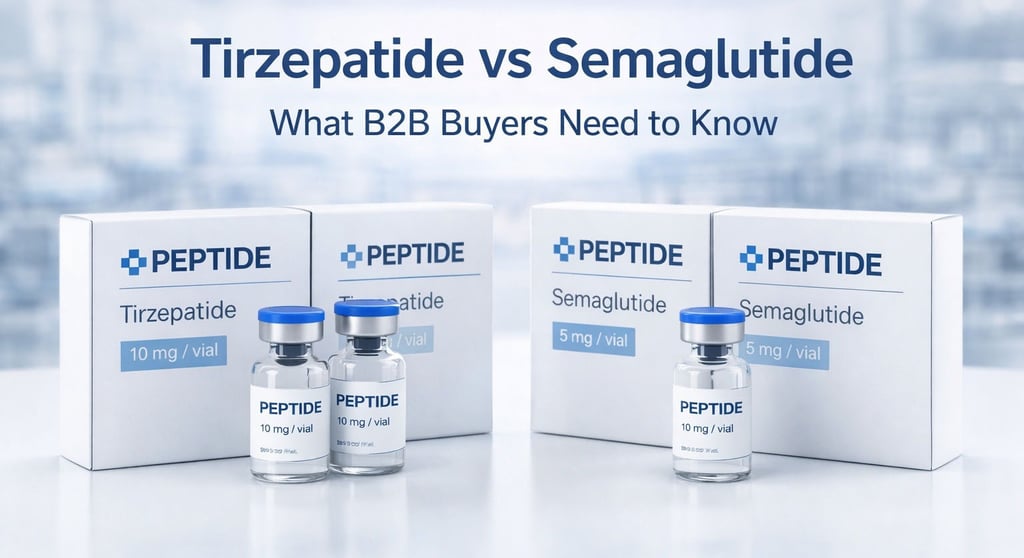
Tirzepatide vs Semaglutide: What Distributors and B2B Buyers Need to Know
Tirzepatide and semaglutide are two of the most closely watched product categories in today’s peptide market. For distributors, sourcing teams, and project-based B2B buyers, interest in both products continues to shape procurement discussions, packaging projects, and long-term supply planning.
Although these two ingredients are often mentioned together, they are not identical from a market, positioning, or supplier-evaluation perspective. Tirzepatide is used in FDA-approved Lilly products including Mounjaro for type 2 diabetes and Zepbound for chronic weight management; semaglutide is used in FDA-approved Novo Nordisk products including Ozempic for type 2 diabetes and Wegovy for chronic weight management. Wegovy labeling now also reflects oral tablet information in the U.S. product information currently published by Novo Nordisk.
For B2B buyers, the practical question is not only which name is more recognized. The more important question is how each category fits into a broader sourcing strategy, including supply discussions, packaging coordination, documentation expectations, and long-term project planning.
Why tirzepatide and semaglutide matter in the B2B market
These two categories attract attention because they sit at the center of one of the largest current market segments in peptide-related demand. Lilly has described Zepbound as the most prescribed weight-management medication in 2025, and both Lilly and Novo Nordisk continue to expand product positioning and commercial activity around tirzepatide and semaglutide.
That commercial momentum matters to B2B buyers. Distributors and sourcing teams often prioritize product categories that combine strong recognition, sustained inquiry volume, and clearer long-term business potential. In practice, that means tirzepatide and semaglutide often receive earlier attention than many smaller peptide categories.
Tirzepatide vs semaglutide: basic product positioning
From a market-positioning standpoint, tirzepatide and semaglutide are related but distinct categories. Tirzepatide is associated with Lilly’s Mounjaro and Zepbound franchises, while semaglutide is associated with Novo Nordisk’s Ozempic and Wegovy franchises. Tirzepatide products are currently promoted by Lilly for type 2 diabetes and for chronic weight management, with Zepbound also promoted for moderate-to-severe obstructive sleep apnea in adults with obesity. Semaglutide products are promoted by Novo Nordisk for type 2 diabetes and chronic weight management, and Wegovy is also promoted for lowering the risk of major cardiovascular events in certain adults with obesity or overweight and established cardiovascular disease.
For a distributor or B2B buyer, this means the two categories may overlap in demand discussions while still sitting in somewhat different market narratives. Tirzepatide often carries a stronger “next-wave” commercial perception, while semaglutide has broader name recognition from earlier market penetration. That is an inference based on their respective commercial profiles and market visibility, not a formal rule.
How distributors compare market interest and buyer demand
In B2B practice, buyers often compare tirzepatide and semaglutide based on three questions:
First, which product currently generates more inquiry momentum?
Second, which one is easier to position within an existing product portfolio?
Third, which category appears more suitable for repeat procurement discussions?
Those answers vary by market and buyer type, but tirzepatide currently has exceptionally strong commercial visibility, while semaglutide remains one of the most recognized names in the category overall. That usually means both deserve attention, but not necessarily the same sourcing strategy.
For some distributors, semaglutide may feel like the more established comparison point. For others, tirzepatide may look more attractive because of current market attention and category momentum. A practical B2B strategy is often to evaluate both rather than assuming one automatically replaces the other.
Supply planning considerations for B2B buyers
From a B2B sourcing perspective, product popularity alone is not enough. Buyers should also compare the operational side of each project.
That includes:
supply stability discussions
packaging format planning
batch consistency expectations
documentation support
repeat-order coordination
OEM or private-label fit
how efficiently the supplier handles project communication
A supplier who can speak clearly about bulk supply, packaging structure, lead-time expectations, and documentation handling is usually more valuable than one who only provides a quick price. That is especially important in highly watched categories, where inquiry volume may be high but supplier quality varies widely.
FDA has also recently warned about fraudulent compounded semaglutide and tirzepatide products marketed in the U.S. with false label information, and Lilly separately issued a March 2026 public warning about potential safety risks tied to compounded tirzepatide mixed with vitamin B12. For B2B buyers, that makes supplier verification, documentation review, and packaging clarity even more important.
Packaging, labeling, and OEM project differences
For buyers planning OEM or customized packaging projects, tirzepatide and semaglutide should both be evaluated through a packaging and communication lens, not just a product-name lens.
Key considerations include:
vial presentation
outer box format
label clarity
batch identification workflow
consistency across repeated packaging runs
supplier responsiveness during design confirmation
whether the supplier can distinguish stock-style supply from custom project handling
In practical terms, the best supplier is usually the one that can explain the packaging workflow clearly and keep labeling, presentation, and project communication organized across repeat orders.
Documentation and quality communication
Documentation is another major checkpoint. Buyers comparing tirzepatide and semaglutide projects should ask how the supplier handles specification review, batch-related files, packaging details, and quality communication during evaluation.
This matters even more now because both product names sit in a highly scrutinized market environment. Official U.S. labeling for tirzepatide and semaglutide products includes boxed warnings about thyroid C-cell tumors observed in rodents and contraindications related to personal or family history of medullary thyroid carcinoma or Multiple Endocrine Neoplasia syndrome type 2. FDA has also stated that the current prescribing information for GLP-1 receptor agonists approved for obesity or overweight includes information about the risk of suicidal thoughts and actions.
For a B2B buyer, the takeaway is straightforward: this is not a category where vague communication is acceptable. Clear product information, organized documentation, and disciplined supplier communication are part of the minimum standard.
Questions buyers should ask before choosing a supplier
Before moving forward with either tirzepatide or semaglutide projects, distributors and B2B buyers should ask:
Do you support bulk supply discussions, OEM projects, or both?
What packaging formats can be discussed?
How do you manage repeat-order consistency?
What documentation can be reviewed during evaluation?
How do you distinguish stock supply from custom project workflows?
What information do you need to assess a serious inquiry efficiently?
How do you handle packaging confirmation and label coordination?
These questions help move the conversation beyond headline pricing and into actual operational fit.
Final thoughts for distributors and project-based buyers
Tirzepatide and semaglutide are both important categories, but they should not be treated as interchangeable from a B2B decision-making perspective. Each sits within a slightly different commercial context, and each may fit a buyer’s portfolio differently depending on market demand, packaging goals, supply planning, and project structure.
For distributors and sourcing teams, the better comparison is not simply which name is bigger. The better comparison is which product category aligns more effectively with your sourcing model, customer demand, documentation expectations, and long-term supplier strategy.
If your team is evaluating tirzepatide or semaglutide supply for a commercial project, the best starting point is a structured inquiry that includes target product, estimated quantity, packaging preference, and destination market. That makes it much easier to determine whether a supplier is prepared for serious B2B cooperation.
Contact
Reach out for partnerships and inquiries
Phone
Email: queens@sciencepeptidelab.com
WhatsApp:
+852 4456 4220 (HK)
+852 9419 6180 (HK)
© 2025. All rights reserved.